Hi there, nice to meet you. Follow me at http://belfong.com/tweets
521 stories
·
2 followers

The iPhone Air Has Not Sold Well

1 Comment

David Smith:

The eve of iPhone 18 Pro pre-orders seems like a good time to look back at the iPhone 17 family’s adoption. Here’s the 17 family data as a percentage of overall usage for Widgetsmith.

Generally, they followed the usual adoption pattern and overall did very well, ending at around 20% of total usage.

With the exception of the Air really struggling to find market share. For comparison, the 16 Plus ended its first year at around 1.4% (vs. the Air’s 0.3%).

The graph is pretty pretty pretty pretty rough for those of us who love the iPhone Air:

Underscore iPhone Numbers

Widgetsmith is huge and is much more representative of real-world performance than apps written for a nerdier audience. I suspect the overall sales of these phones look a lot like this chart.

I believe we’ll see an update to the Air in the spring, with the same rear camera system as found on the iPhone Duo. Past that? I think Apple may pull the plug.

Read the whole story
Belfong
1 hour ago
reply
NOOOOO! I love the Air! Don't die!
malaysia
Share this story
Delete

9/11 entrenched Islamophobia in US politics. But it doesn’t work the way you think | Moustafa Bayoumi

1 Comment

Anti-Muslim sentiment is used as a political weapon. Meanwhile, Muslim American leaders are making a difference for all

It’s been 25 years since the terrorist attacks of September 11, and during this time Muslim Americans have learned how to live in that dangerous space between other Americans’ fears and their ignorance.

The fear was clear from the beginning. Immediately following 9/11, Muslim Americans faced what Human Rights Watch called “a severe wave of backlash violence”. A tide of hate rose up against ordinary Muslims and those who appeared to be Muslim, including at least three murders in the immediate backlash after the attacks. The federal government, for its part, began targeting Muslim immigrants in a massive surge of repression that legal experts soon compared with the Palmer Raids of the 1920s.

Continue reading...

Read the whole story
Belfong
18 hours ago
reply
I want to read this in detail. Keeping it here.
malaysia
Share this story
Delete

Audio Intelligence

1 Comment

Apple:

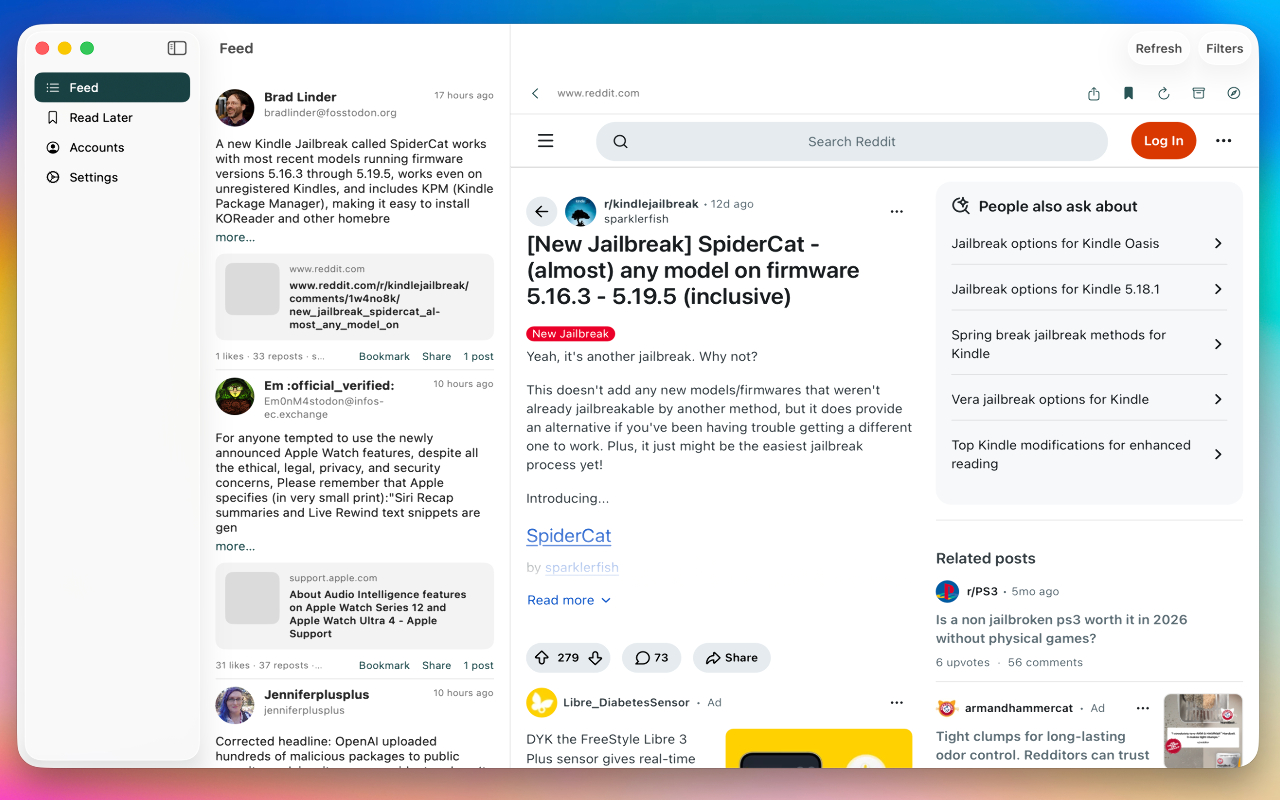
Audio Intelligence is a brand-new class of Apple Intelligence features that use the microphones of Apple Watch, the power of Apple silicon, and on-device and cloud-based AI models to help you detect sounds, identify music, and stay present and engaged — all while protecting your privacy at every step.

Hartley Charlton:

  • Siri Recap: Uses ambient listening to generate high-level notes from conversations, such as takeaways from a team meeting or a parent-teacher conference, producing an Apple Intelligence-generated title, summary, and key points reviewable in the Siri app.
  • Live Rewind: Lets users “go back in time for 15 seconds,” transcribing and displaying what was just said in a conversation with a double press of the Digital Crown.
  • Shazam: Automatically identifies music playing nearby and surfaces the song title and artist on the Music Recognition widget in the Smart Stack.
  • Sound Recognition: Brings sound alerts to Apple Watch for users who are deaf or hard of hearing, listening for sirens, alarms, doorbells, a baby crying, and more, even when their iPhone isn’t nearby.

Lily Hay Newman:

Apple is emphasizing that all of them are built to prioritize privacy and security using the extensive infrastructure the company has developed to protect its other Apple Intelligence and Siri services. As more and more of these types of features debut, though, the audio intelligence announcements are a reminder that AI-powered tools are becoming increasingly universal in all areas of computing and life.

“These features do not create or store audio recordings, and raw audio used for processing is completely inaccessible to the operating systems, apps, the user, or Apple,” the company wrote in a report shared with WIRED.

[…]

Apple emphasizes that its on-device capabilities for Apple watches have expanded thanks to the company’s new S11 chips. The chips include a special memory-protected space that Apple calls the Secure Exclave. Designed specifically for sensor data, the exclave is an isolated buffer that is inaccessible to the rest of the operating system where Apple Watch can hold and process audio data in a protected space.

[…]

To try to mitigate blatant privacy violations, Apple says that the watch produces an audible chime when a watch owner initiates a Live Rewind transcript to alert other people in the area—even if it is on silent mode or paired with headphones. And the features are built to omit or filter out potentially identifying information about speakers. But the sheer scope and breadth of the tools is extremely noteworthy.

Zac Hall:

If you want to really take a deep dive on privacy and the new features, Apple has published an 11-page privacy paper that goes even further.

Previously:

Read the whole story
Belfong
18 hours ago
reply
What’s this new AI?
malaysia
Share this story
Delete

★ And It’s True That I Stole Your Lighter, and It’s Also True That I Lost the Map

1 Comment

Last week both Google and Apple updated their maps to accommodate Trump changing the United States Geological Survey’s recognized name for Lake Ontario to “Lake America”. Just as with Trump’s fiat renaming of the Gulf of Mexico back in the first days of his 2.0 administration, Google and Apple are showing the same names to the same people, by region. Here are the names you now see for Lake Ontario, based on what region your device is set to:

  • United States: “Lake America”
  • Canada: “Lake Ontario”
  • Everywhere else in the world: “Lake Ontario (Lake America)”

This is exactly the same as their joint solution to the Gulf of Mexico renaming — the U.S. sees “Gulf of America”, Mexico sees “Gulf of Mexico”, and the rest of the world sees “Gulf of Mexico (Gulf of America)”.

Here is the solution I strongly believe Google and Apple should follow:

  • United States: “Lake America (Lake Ontario)” and “Gulf of America (Gulf of Mexico)”
  • Everywhere else in the world: “Lake Ontario” and “Gulf of Mexico”

There is no reason to show these new Trump-dictated names anywhere outside the U.S., even putting them in parentheses. There is no reason to show only the actual traditional names exclusively for users in Canada (for Lake Ontario) and Mexico (for the Gulf). Treating Canada and Mexico as special cases only makes sense if they’re part of some sort of dispute over the names. They’re not. The names of these two bodies of water are not contentious. There is no long-simmering debate about them, like there is with Denali/Mount McKinley in Alaska. The one and only country on the planet with a crackpot kook-ridden government that claims these bodies of water have new names is the United States; the only country that should see the new names is the United States.1

So, I disagree with how Google and Apple have chosen to handle these re-namings. But it is correct that users in the United States do see the new names.

Here’s Andy Ihnatko, at his eponymous website:

We all have every right to be upset. Google’s receiving plenty of flak over this move (as is Apple; Apple Maps now shows “Lake America,” reportedly after being pressured directly by Trump). I dislike Google’s and Apple’s choices, but I can’t personally fault them.

That said, Trump’s move is clearly meant to antagonize Canada during a volatile period in our relations. He’s throwing gasoline on a tariff fight that’s already creating uncertainty and suffering among vulnerable businesses and consumers on both sides of what was once an impeccably peaceful border. Google and Apple didn’t need to move so damned quickly. I wish they’d deferred the name change long enough for things to cool down a little. Doing so would have avoided creating the perception of handing one side a swift, validating victory.

I doubt a cooling-off period would help. Wounds don’t feel better when they’re reopened after healing. It’s best to get it over with. Applying the change to Google and Apple Maps while the GNIS database ink is still wet at least serves to remind who made this change and why. And whose change it rightfully is to make.

This is a bitter pill for some to swallow. What a lot of people want is for Google and Apple to just ignore the U.S. government’s official new names. E.g., to pick just one high-profile pundit, here’s Kara Swisher regarding Google (“quislings”) and Apple (“craven”, “pathetic”). But I suspect, quite strongly, that the people who profess to be the most angry at Apple and Google for going along with this change are the same people who would argue most strongly that Goliath tech companies and mega-billionaires wield too much anti-democratic power and influence.

It’s not coherent to argue that Google and Apple should decide which names to put on their maps only when you want them to ignore the names from the official government database. Neither Google nor Apple are going to sell their maps apps, but it’s not outlandish to think that in some alternative universe, one or more of the leading maps app might be owned by, say, Elon Musk or Larry Ellison. Would the people who want Apple and Google to ignore the official names from the GNIS support the same stance if the two leading maps apps were owned by SpaceX and Oracle instead? Obviously they would not.

What we want is a system where geographic names are determined democratically, by voting. And that is the system we in fact have. Trump won. The Department of the Interior has the power to change these names. If you’re angry that their official names in the United States are now Lake America and Gulf of America, stay angry that Trump won the 2024 election. Stay angry that our president continues to debase his office and embarrass our nation. Directing your anger at Google and Apple for reflecting that change is shooting the messengers.

But this is why I find it embarrassing that both Google and Apple are foisting these absurd names on the rest of the world, even if only between parentheses. These names are nonsense, and they are Americans’ nonsense to deal with.

China is another country with ridiculous geographic dogma. China demands that Taiwan, which is an independent free nation, be falsely labelled as a province of China. Apple Maps reflects that policy — within China. It doesn’t label Taiwan as “(Province of China)” on maps outside China. Bullshit inside parentheses is still bullshit. Less seriously but more preposterously, the Chinese government also insists that the obscure Diaoyu Islands, subject of a long-running territorial dispute with Japan, be drawn larger than they actually are on maps. Apple Maps dutifully renders those inflated false island sizes to users in China. It doesn’t show them to users anywhere else in the world — not even as dotted outlines. Chinese users see Chinese government dogmatic nonsense; no one else does.

So too it should be for U.S. government dogmatic nonsense. Spreading the nonsense to the rest of the world only makes it more embarrassing.

Neither Google nor Apple claim to be cartographic editorial authorities. I do not think we should want them to be. Other non-governmental institutions do claim to be independent authorities. The Associated Press has stuck to their guns even in the face of losing its White House press pool seat over their refusal to adopt the “Gulf of America” name. And then there’s Wikipedia, whose reputation, integrity, popularity, and independence haunt the right wing. From Politico, last week:

Other platforms will soon follow, a senior administration official told Politico on Tuesday. “We got Lake America changed on Google Maps, and many other maps are changing in a couple days. And Wikipedia is going to change as well,” said the official, who was granted anonymity to speak frankly.

As of Wednesday, Wikipedia was still using the original names of both the Gulf of Mexico and Lake Ontario, while noting that Trump had signed orders to rename them.

Regarding this, Molly White noted:

A Wikipedia editor put it well: “You almost want to pat them on the head and say ‘Yes, of course it will’ in the same way you’d tell a small child that Santa Claus will be delivering their presents.”


  1. And, I feel strongly, the traditional names should remain visible, in parentheses, even for users in the U.S. for a period of, say, five years. What is someone who doesn’t follow current events — god bless them — to think if they go looking for Lake Ontario on Google Maps or Apple Maps and don’t see it? ↩︎

Read the whole story
Belfong
4 days ago
reply
This is a good point. Keep US bullshit inside the US and keep the rest of the world out of it.
malaysia
Share this story
Delete

How everyday US investors are vibe-coding algorithms to automate trading strategies by connecting their stock portfolios to AI agents built with Claude or Codex (Hannah Erin Lang/Wall Street Journal)

1 Comment

Hannah Erin Lang / Wall Street Journal:
How everyday US investors are vibe-coding algorithms to automate trading strategies by connecting their stock portfolios to AI agents built with Claude or Codex  —  Americans are vibe-coding trading algorithms and handing over their stock portfolios to AI agents.  Welcome to the world of the robot retail investor.

Read the whole story
Belfong
4 days ago
reply
This reminds me of an incident many years ago where a friend asked me to try a robot managed forex trading. Yikes.
malaysia
Share this story
Delete

A record 12.7M graduates are entering China's workforce in 2026 as AI adds uncertainty to an oversaturated job market with a shrinking pool of entry-level roles (Yan Zhuang/New York Times)

1 Comment

Yan Zhuang / New York Times:
A record 12.7M graduates are entering China's workforce in 2026 as AI adds uncertainty to an oversaturated job market with a shrinking pool of entry-level roles  —  A record 12.7 million young people are looking for jobs as the country embraces artificial intelligence — and as the technology begins to upend the work force.

Read the whole story
Belfong
4 days ago
reply
This is quite worrisome for the future generations e.g. my children.
malaysia
Share this story
Delete
Next Page of Stories